
The Evolution of AI and Technology Resellers: From Traditional Providers to Strategic AI Partners in America
The technology reseller and professional services industry in America stands at a pivotal inflection point. For decades, Value-Added Resellers (VARs), Managed Service Providers (MSPs), and IT consultants operated on models centered around hardware and software markups, break/fix support, and time-and-materials billing. Today, those models face intense pressure from cloud marketplaces, direct vendor relationships, and commoditization. Artificial Intelligence is not merely disrupting this sector, it is redefining it entirely.
Forward-looking companies are transitioning from reactive service providers to proactive, outcome-driven strategic partners. This evolution is creating new revenue streams, higher margins, and deeper client relationships, but only for those who adapt quickly.
The Pressures Driving Change
Traditional reseller economics have eroded as clients increasingly buy directly from hyperscalers and expect more than just product delivery. Talent shortages, rising labor costs, and inconsistent service quality further strain operations. Clients now demand measurable business outcomes: reduced downtime, stronger security postures, lower operational costs, and accelerated innovation.
AI addresses these challenges head-on by automating routine tasks, predicting problems before they occur, and enabling scalable, high-value services.
How AI Is Transforming Operations
1. From Reactive to Predictive Service Delivery
AIOps platforms analyze vast amounts of telemetry data across client environments to forecast failures, optimize cloud spending, and automate remediation. This shift dramatically reduces mean time to resolution (MTTR) and moves providers from constant firefighting to proactive guardianship.
Service desks are being revolutionized as well. AI-powered chatbots, intelligent ticket routing, and auto-resolution engines now handle 40-60% of routine incidents, delivering significant productivity gains for technical teams.
2. The Rise of Agentic AI and Managed Intelligence
The next frontier is agentic AI, autonomous systems capable of reasoning, executing workflows, and adapting to changing conditions with minimal human intervention. MSPs that master these technologies can offer "Managed AI" or "Managed Intelligence" services, often priced on outcomes rather than hours or devices.
This creates entirely new service categories, from AI governance and compliance to custom agent orchestration and integration.
3. Cybersecurity Reimagined
AI is both a powerful defender and a sophisticated attacker. Resellers and MSPs are embedding AI into security operations for behavioral analysis, automated threat hunting, and predictive defense. In 2026, AI-enabled cybersecurity is becoming a core differentiator rather than a bolt-on feature.
Emerging threats, including agentic AI attacks, deepfakes, shadow/stealth AI, and quantum risks, require modern solutions that traditional tools cannot adequately address.
Real-World Leadership: DTG and the RNP Capital Partnership
A strong example of this evolution in action is Distributed Technology Group (DTG), a veteran-led IT solutions provider specializing in cybersecurity, cloud, AI, and modernization services for enterprise and public sector clients.
DTG’s strategic alliance with RNP Capital, an operator-led venture capital firm, demonstrates how smart capital combined with proven execution infrastructure accelerates transformation. RNP brings funding and operational expertise from seasoned builders, while DTG contributes trusted delivery capabilities, SOC expertise, and long-standing client relationships.
This partnership model helps overcome common barriers: access to capital for innovation, early access to cutting-edge technologies, and rapid scaling of AI-driven solutions. DTG’s focus on secure, responsible AI adoption and modernization positions it as a strategic advisor rather than a commodity supplier
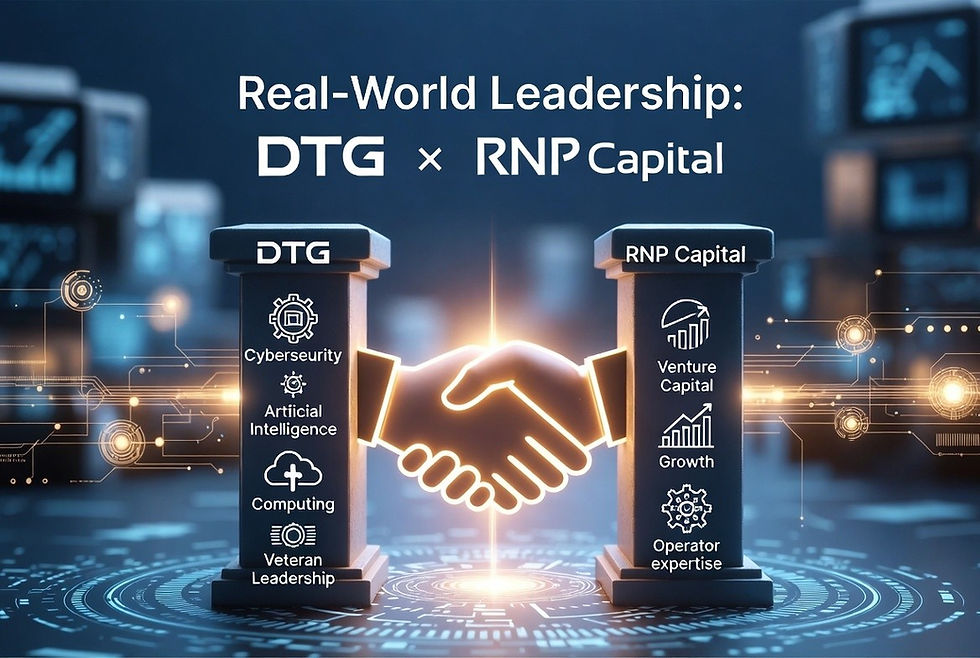
Accelerating AI Transformation: DTG and RNP Capital
Post-Stealth and Leading-Edge Technologies Shaping Tomorrow
The most impactful innovations often emerge from stealth-mode development or represent advances beyond traditional paradigms. These technologies directly tackle the complex challenges facing institutions and businesses today:
Agentic AI Systems: Autonomous agents that handle complex operations while incorporating security, governance, and explainability throughout their lifecycle.
Adaptive AI-Driven Defense: Predictive threat intelligence, behavioral analytics, and automated response systems that counter AI-enhanced attacks, including polymorphic malware and indirect prompt injections.
Quantum-Resistant Cryptography: Solutions that protect against “harvest now, decrypt later” attacks as quantum computing matures.
SASE, ZTNA, and Edge Intelligence: AI-embedded secure access and low-latency edge computing for real-time decision-making in distributed environments.
Responsible AI Orchestration: Tools for bias detection, compliance, data governance, and ethical deployment, areas where resellers can add tremendous value through consulting and managed services.
These post-stealth capabilities allow resellers to address pressing issues such as expanding attack surfaces, talent shortages, regulatory complexity, and the need for resilient hybrid/multi-cloud architectures.
Opportunities and Strategic Imperatives for 2026 and Beyond
Successful technology resellers and pro services firms will focus on several key areas:
Internal AI Mastery First: Use AI to transform their own operations before selling it to clients, building credibility and operational efficiency.
Outcome-Based Business Models: Shift pricing toward results (e.g., guaranteed uptime, cost savings, or risk reduction).
Vertical Specialization: Deep expertise in regulated sectors like healthcare, finance, and government creates defensible advantages.
Strategic Alliances: Partnerships for capital, technology access, and complementary capabilities, as exemplified by DTG and RNP Capital.
Talent Evolution: Move from traditional technicians to AI orchestrators, strategists, and client advisors.
Industry predictions for 2026 are clear: AI will move from experimentation to core operational reality. MSPs and resellers that embrace this shift will thrive as indispensable partners in their clients’ digital transformation journeys.
Conclusion: Leading the AI Revolution
The AI revolution is not coming for technology resellers; it is inviting them to lead it. Those who cling to outdated models risk being disintermediated. Those who invest in AI capabilities, forge smart partnerships, and commit to delivering measurable client outcomes will emerge as the industry leaders of tomorrow.
The reseller of the future will not be a middleman moving boxes or hours. They will be a trusted strategic advisor, AI systems integrator, and innovation accelerator, essential to both business and institutional success in an increasingly complex world.
For technology leaders, the message is urgent: the time to evolve is now.
What are your thoughts on the future of technology resellers and MSPs in the AI era?


Comments